Born in....
Let's review art history year by year, with artists born since 1853, the birth year of Vincent VAN GOTH, what a perfect year to start this journey! For each year you will find an artists inventory and 3 to 6 remarkable painters with their creations.
In 1883
In 1882 were born Gino SEVERINI, Theo VAN DOESBURG and Jean METZINGER.
This year proved to be a pivotal transitional period in art, capturing major shifts in European Impressionism, setting the stage for Post-Impressionism, and witnessing the end of an era with the deaths of major masters.
On April 20, 1883, Claude Monet moved to the French village of Giverny. It was here that he constructed his famous Japanese-inspired water garden and began his legendary decades-long focus on painting water lilies. Pierre-August Renoir shifted away from strict Impressionism following a trip to Italy. He completed a famous trio of dance paintings such as Dance in the country. In Brussels, the avant-garde group Les XX (The Twenty) was established on October 28, which would soon become a critical vehicle for showcasing Post-Impressionism and Symbolism.
Gino SEVERINI

Blue dancer
Theo VAN DOESBURG

Woman
Jean METZINGER

Woman with a mandolin
In 1882
In 1882 were born Edward HOPPER, George BELLOWS and Umberto BOCCIONI.
This year stood as a pivotal crossroads in art history, marked by the pinnacle of Impressionism and the final masterpiece of Édouard Manet "A bar at Folies Bergeres". While the established art world congregated at the official Paris Salon, the independent avant-garde held what many art historians consider to be the finest and purest of all the Impressionist group exhibitions.
Edward HOPPER

Nighthawks
George BELLOWS

Dempsey and Firpo
Umberto BOCCIONI

The charge of the lancers
In 1881
In 1881 were born Pablo PICASSO, Fernand LEGER, Natalia GONCHAROVA, Carlo CARRA, Ilya MASHKOV and Max PECHSTEIN.
This year was a foundational turning point for modern art, bridging the height of Impressionism with structural institutional shifts and the births of pillars of 20th-century avant-garde. The French government officially withdrew its support from the Paris Salon, leading to the creation of the independent Société des Artistes Français and unleashing a wave of creative freedom.
Vincent van Gogh returned to his parents' home in Etten. He began his formative, early period focusing on heavy peasant studies and rustic still lifes.
Pablo PICASSO

Weeping woman
Fernand LEGER

The three musicians
Natalia GONCHAROVA

Fishing
Carlo CARRA

La casa dell'amore
Ilya MASHKOV

Nudes in the studio
Max PECHSTEIN

Girl on a green sofa with a cat
In 1880
In 1880 were born Franz MARC, Hans HOFMANN, Ernst Ludwig KIRCHNER, Andre DERAIN, Arthur DOVE and Adrien Jean LE MAYEUR.
This year witnessed the birth of Symbolism, and foundational shifts in modern sculpture. While Academic art still dominated European salons, groundbreaking masters began redefining boundaries. In Paris, the Fifth Impressionist Exhibition opened, continuing to challenge the traditional Salon.
Moving away from everyday realism, the Symbolist movement found its haunting visual anchor in 1880.
In three-dimensional art, 1880 marked a historic commission that reshaped modern sculpture forever with Auguste Rodin commissioned by the French government to design The Gates of Hell. Within this massive project, Rodin conceived a small figure meant to sit atop the lintel—a piece that would eventually become his most famous independent bronze, The Thinker.
The National Gallery of Canada was founded in Ottawa.
Franz MARC

The fox
Hans HOFMANN

Lava
Ernst Ludwig KIRCHNER

Self-portrait as a soldier
Andre DERAIN

Arbres a Collioure
Arthur DOVE

Nuns
Adrien Jean LE MAYEUR

Weavers
In 1879
In 1879 were born Paul KLEE, Francis PICABIA and Othon FRIESZ.
This was defined by landmark exhibitions in Paris, the foundation of lasting cultural institutions and the production of several masterpieces across both Academic and Impressionist styles.
-The Fourth Impressionist Exhibition: Held in Paris, this exhibition was highly successful and turned a major profit, attracting four times as many visitors as their debut in 1874. It featured 16 artists showing around 270 works.
- The Paris Salon: The 96th official exhibition opened at the Palace of Industry. It featured highly regarded Academic masterpieces as well as submissions from artists associated with the Impressionist movement, such as Édouard Manet and Pierre-Auguste Renoir. In the same year was founded:
- The Chicago Academy of Fine Arts (renamed the Art Institute of Chicago in 1882).
- The Guimet Museum in France and the Museum of Fine Arts Berne in Switzerland.
Paul KLEE

Tanzarin
Francis PICABIA

Craccae
Othon FRIESZ

Temptation
In 1878
In 1878 were born Kuzma PETROV-VODKIN, Boris KUSTODIEV and William ORPEN.
This year marked by the rapid expansion of Impressionism, deep personal shifts for master painters and a fascination with narrative realism. In Paris, the major cultural anchor of the year was the Exposition Universelle of 1878, which brought global artistic styles into a single spotlight.
Outside of Impressionism, 1878 saw brilliant Narrative & Historical Realism works that focused on high-stakes emotion, historical drama and social commentary with artists like William Frederick YEAMES, Edwin LONG, Edmund Blair LEIGHTON.
Kuzma PETROV-VODKIN

The alarm
Boris KUSTODIEV

Russian Venus
William ORPEN

The studio
In 1877
In 1877 were born Kees VAN DONGEN, Marsden HARTLEY, Raoul DUFY, Joseph STELLA, Laura KNIGHT and Tom THOMSON.
This year was a pivotal moment in late 19th-century art history, most notably marked by the Third Impressionist Exhibition in Paris and a fierce public debate in London that led to a famous libel lawsuit.
Major Art Events & Exhibitions
The Third Impressionist Exhibition: Organized primarily by Gustave Caillebotte this was the first of their eight exhibitions to officially use the word "Impressionist" above the entrance door. It featured seminal masterpieces including Pierre-Auguste Renoir's Bal du moulin de la Galette and multiple views of the Gare Saint-Lazare by Claude Monet.
The Ruskin–Whistler Controversy: In London, the Grosvenor Gallery opened its inaugural exhibition featuring James McNeill Whistler's avant-garde Nocturne in Black and Gold – The Falling Rocket. The influential English art critic John Ruskin published a scathing review, accusing Whistler of "flinging a pot of paint in the public's face," prompting Whistler to sue him.
Kees VAN DONGEN

La quietude
Marsden HARTLEY

Give us this day
Raoul DUFY

La foire aux oignons
Joseph STELLA

Tree of my life
Laura KNIGHT

A balloon site
Tom THOMSON

The west wind
In 1876
In 1876 were born Constantin BRANCUSI, Maurice DE VLAMINCK and Julio GONZALEZ.
This year was a historic turning point in the art world, defined by the explosive growth of French Impressionism and a massive celebration of cultural modernity in the United States. In Europe, avant-garde painters defied the conservative Salon academies by capturing the fleetness of modern life, shifting light, and psychological isolation. Meanwhile, across the Atlantic, the monumental 1876 Centennial Exposition in Philadelphia pushed American Realism into the international spotlight, showcasing artists who grappled with the complex social identity of a post-Civil War nation.
Constantin BRANCUSI

Danaide
Maurice DE VLAMINCK

Woman with a dog
Julio GONZALEZ

Masque ombre et lumiere
In 1875
In 1875 were born Albert MARQUET and Meynard DIXON.
This year marks a foundational period for modern art, driven by the emergence of the Impressionist movement in France and changing institutional landscapes in the United States. As artists increasingly broke away from strict academic rules, they shifted their focus toward capturing atmospheric light, everyday scenes, and emotional subjectivity.
Major Events:
- Founding of the Art Students League of New York: Progressive American artists seeking alternatives to the traditionalist National Academy of Design banded together to provide a new hub for modern studio training.
- Preparation for the Second Impressionist Exhibition: Following their radical debut in 1874, core members spent 1875 experimenting heavily with technique and composition for their next major group show in Paris.
Albert MARQUET

Nude on a blue background
Meynard DIXON

Desert journey
Konstantin YUON

The provincials
In 1874
In 1874 were born Nicholas ROERICH, Winston CHURCHILL and Joaquin Torres GARCIA.
This year is widely considered one of the most significant milestones in Western art history, marking the official birth of Impressionism. Frustrated by the strict aesthetic rules and high rejection rates of the official, government-sanctioned Paris Salon a breakout collective of radical artists decided to bypass the establishment entirely. On April 15, 1874, they opened the First Impressionist Exhibition in Paris, fundamentally changing how the world viewed light, motion, and everyday life. Rather than aiming for high academic finish, historical allegory, or microscopic detail, these creators used loose, visible brushstrokes and bright palettes to catch fleeting "impressions" of modern life.
The Painting that Named the Movement: Claude Monet's Impression, Sunrise was the standout piece of the show. Intended to depict the hazy harbor of Le Havre, its sketch-like finish provoked art critic Louis Leroy to mockingly label the entire group "Impressionists"—a derogatory jab the artists proudly adopted. Other Breakthrough Masters: The exhibition featured vital masterworks from Pierre-Auguste Renoir "La Loge", Edgar Degas "The Dance Class", Camille Pissarro and Paul Cézanne. The Pioneer Woman: Berthe Morisot stood out as the sole female member displaying works and offering a brilliant, luminous look into the domestic and social spheres of 19th-century women.
Nicholas ROERICH

Spring in Kulu
Winston CHURCHILL
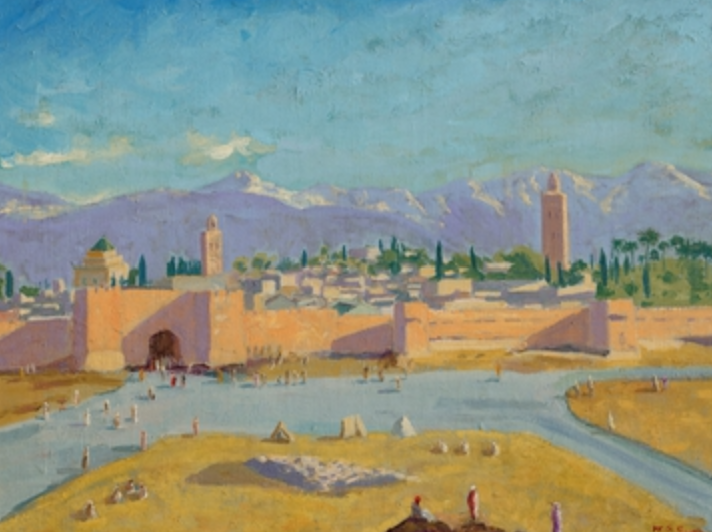
Tower of the Koutoubia Mosque
Joaquin Torres GARCIA

Quattro figuras e charrete
In 1873
In 1873 was born J.E H. MAC DONALD.
Major events:
- The Paris Salon & Salon des Refusés: The official Salon of 1973 displayed the height of Belle Époque academic styling. Highly praised pieces included Alphonse de Neuville's heroic Franco-Prussian war scene The Last Cartridges and William-Adolphe Bouguereau's classical Nymphs and Satyr. Concurrently, a separate Salon des Refusés accommodated artists rejected by the strict jury, laying structural groundwork for the independent Impressionist exhibition the following year.
-The Royal Academy (London) achieved remarkable diversity, with women artists making up nearly 10% of the roster. Figures like Louisa Starr and Martha Darley Mutrie were singled out by The Times as part of a "very distinguished group" redefining their roles beyond traditional flower painting.
- Birth of the Société Anonyme: In Paris, Claude Monet, Pierre-Auguste Renoir, Camille Pissarro, and Alfred Sisley founded the Société Anonyme Coopérative des Artistes Peintres, Sculpteurs, Graveurs, etc.. This critical organization allowed them to bypass official channels and showcase independent modern art.
J.E H. MAC DONALD

Northland hilltop
Ernest LAWSON

Market Square, Segovia
Frances MacDONALD

The choice
In 1872
In 1872 was born Piet MONDRIAN.
Major events:
- The Birth of Impressionism: In November 1872, Claude Monet painted Impression, Sunrise from his hotel window in Le Havre. When exhibited two years later, its title inspired a critic to coin the term "Impressionism" as an insult. The name stuck, defining a revolution.
- On February 20, The Metropolitan Museum of Art officially opened its doors to the public in NY.
- Whistler’s Breakthrough: American-born painter James McNeill Whistler exhibited his iconic Arrangement in Grey and Black: The Artist's Mother (painted in 1871) at the Royal Academy in London. It only avoided rejection because a prominent curator threatened to resign if it wasn't shown.
Other masterpieces: John Gast – American Progress. An allegory of "Manifest Destiny," this painting became a famous cultural artifact, portraying a floating, ethereal Columbia leading American settlers West and bringing light to the dark frontier. Peter Nicolai Arbo – The Wild Hunt of Odin. A dramatic, dark masterpiece of Norse folklore showing Odin, Thor, and the Valkyries tearing through a terrifying mid-winter night sky. Berthe Morisot – The Cradle. One of the most celebrated works by a female Impressionist, showing Morisot’s sister watching over her sleeping baby behind a gauze veil.
Piet MONDRIAN

Place de la Concorde
Byam SHAW

Garden of Kama
Ethel CARRICK

From garden to the beach
In 1871
In 1871 were born Lyonel FEININGER, Giacomo BALLA, Emily CARR and Alfredo Ramos MARTINEZ.
This year the brief, radical socialist government of the Paris Commune heavily disrupted the French art world. Realist painter Gustave Courbet famously led the Federation of Artists and pushed for the dismantling of the Vendôme Column, a symbol of Napoleonic imperialism. When the Commune fell during the bloody suppression by French government forces, the trauma left an immediate mark on art such as Édouard Manet, The Barricade: Captured the raw brutality of the conflict, depicting army troops executing socialist Communards on the streets of Paris, Gustave Courbet, Still Life Series: Following the collapse of the Commune, Courbet was imprisoned for his involvement. Behind bars, he produced a somber series of still-life paintings depicting bruised, aging fruit, which served as a subtle metaphor for his own political confinement and the passage of time and Gustave Doré, The Enigma: An allegorical masterpiece created in the wake of the war, illustrating a bleak, apocalyptic landscape where the angel of humanity questions a Sphinx about the horrific nature of human conflict.
Lyonel FEININGER

Benz
Alfredo Ramos MARTINEZ

The potters
Emily CARR

Old time coast village
In 1870
In 1870 were born Maxfield PARRISH, Maurice DENIS, John MARIN.
This year was a pivotal turning point in art history, marked by the dramatic disruption of the Franco-Prussian War and the foundational stirrings of the Impressionist movement. As geopolitical conflict scattered the French avant-garde, artists began shifting away from rigid academic traditions to experiment with light, everyday subjects, and atmospheric landscapes.
Iconic Paintings: The Boyhood of Raleigh by John Everett Millais: This famous British Pre-Raphaelite painting depicts a young Sir Walter Raleigh sitting on the beach. Bazille's Studio by Frédéric Bazille: Completed shortly before his death, this painting offers an intimate glimpse into the early Impressionist circle, featuring cameos by Édouard Manet, Claude Monet, and Auguste Renoir. The Wave by Gustave Courbet: A striking example of Realism, Courbet captured the raw, stormy texture of the ocean with heavy palette-knife paint application.
Maxfield PARRISH

Daybreak
Maurice DENIS

Afternoon in the woods
John MARIN

Lobster boat, cape Split
In 1869
In 1869 were born Henri MATISSE , Konstantin SOMOV and Harald SOHLBERG.
This year stands as a pivotal threshold in art history, widely considered the precise moment when the foundational techniques of Impressionism were born. It was a year defined by rebellion against traditional academic styles, experimentation with natural light, and the births of future masters who would later reshape the 20th century. In the summer of 1869, close friends Claude Monet and Pierre-Auguste Renoir set up their easels side-by-side at La Grenouillère, a popular floating restaurant and boating resort on the Seine River. Working "en plein air" (outdoors), both artists sought to capture the fleeting effects of sunlight on water and the casual recreation of the Parisian middle class. They threw out the academic playbook of smooth blending, dark glazes, and clean outlines. Instead, they utilized:
- Rapid, visible brushstrokes to depict moving water.
- Flecks and dabs of pure color that blurred exact outlines
- A luminous, bright palette that favored sunlit colors over traditional grays and browns.
Though Monet famously dismissed his work from that summer as "bad sketches," art historians point to these twin paintings of La Grenouillère as the spark that launched Impressionism, five years before their first official independent exhibition in 1874.
Henri MATISSE

Odalisque couchee aux magnolias
Konstantin SOMOV

Sleeping lady on blue sofa
Harald SOHLBERG

Fisherman cottage
In 1868
In 1868 were born Edouard VUILLARD, Giovanni GIACOMETTI, Emile BERNARD and Cuno AMIET.
This year was a foundational milestone in art history, serving as a critical bridge toward Modernism. In France, the roots of Impressionism deepened as avant-garde painters challenged traditional salon standards. Meanwhile, in Britain, the Aesthetic Movement gained formal momentum, championing the influential concept of "Art for Art’s Sake."
Notable Masterpieces: Among the Sierra Nevada – Albert Bierstadt: A breathtaking, idealized manifestation of the American West that fueled the concept of Manifest Destiny. Femme a la vague – Gustave Courbet: A bold, realist exploration of the female form seamlessly integrated with the raw power of nature. Fisherman with a net – Frédéric Bazille: An early Impressionist milestone highlighting the interaction of natural outdoor sunlight on a human subject.
Incubation of impressionism: Before organizing their first independent exhibition in 1874, core members of the Impressionist circle—including Édouard Manet, Claude Monet, and Frédéric Bazille—spent 1868 capturing modern Parisian life, changing landscapes, and unique lighting conditions.
The Birth of "Pure Art": In Great Britain, 1868 marked the formal introduction of the phrase "Art for Art's Sake" to describe contemporary British painters. Critics and figures like William Michael Rossetti and Algernon Charles Swinburne published influential pamphlets promoting a "pure art". They argued that art should be judged strictly by its aesthetic beauty rather than its moral or narrative lesson.
Edouard VUILLARD

The flowered dress
Giovanni GIACOMETTI

View of Flims
Emile BERNARD

Breton women with parasols
In 1867
In 1867 were born Emil NOLDE, Pierre BONNARD and Guy ROSE.
Key events:
The massive 1867 Paris Exposition Universelle became the epicenter of the global cultural scene. Japan opened first official pavilion, showcasing traditional woodblock prints (ukiyo-e), kimonos, and ceramics. This sparked a profound, sweeping obsession among Western painters known as Japonisme.
While the official state Salon of 1867and the Exposition celebrated established Academic painters like Jean-Léon Gérôme, Alexandre Cabanel, and Ernest Meissonier, the selection committee was notoriously brutal. They flatly rejected submissions from nearly all the core avant-garde artists, including Claude Monet, Pierre-Auguste Renoir, Camille Pissarro, and Paul Cézanne. Frustrated by their exclusion, pioneers Gustave Courbet and Édouard Manet took a radical step: they built their own private, independent pavilions right outside the World's Fair gates on the Avenue de l'Alma.
End of an Era: The year also marked a symbolic changing of the guard with the death of Jean-Auguste-Dominique Ingres. As the undisputed titan of French Neoclassicism, his passing visually closed the chapter on strict line work and historical idealism, clearing an open path for the loose brushwork and sensory reality of the modern era.
Emil NOLDE

Herbstmeer
Pierre BONNARD

Une terrasse a Grasse
Guy ROSE

Oak grove, Carmel
In 1866
In 1866 were born Wassily KANDINSKY.
Major Artworks:
Gustave Courbet shocked the art world with L'Origine du monde an explicit close-up oil painting that challenged traditional notions of the female nude and Winslow Homer produced one of his defining early works: Prisoners from the Front, capturing a tense confrontation following a Civil War battle.
Édouard Manet painted Young Lady, showcasing his distinctively modern, observational approach.
Carl Bloch painted In a roman Osteria, a Danish masterpiece famous for the intense, direct, and "judgmental" gazes directed from the subjects to the viewer and Paul Cézanne experimented with heavy impasto, creating The Artist's Father, Reading "L'Événement" and Promenade.
Key Events & Exhibitions:
The Royal Academy Exhibition: Held at London's National Gallery, this academy featured Daniel Maclise's The Death of Nelson and Edwin Landseer's The Arab Tent.
Edmonia Lewis in Rome: The pioneering Black Indigenous American sculptor opened her studio in Rome and carved her notable marble bust, Bust of Helen Ruthven Waterston.
Wassily KANDINSKY

Composition 8
Leon BAKST

The yellow Sultana
Roman CASAS

Decadent young woman
In 1865
In 1865 were born Valentin SEROV, Felix VALLOTTON and Suzanne VALADON.
This year marked a monumental turning point, underscored by groundbreaking shifts in European painting and a dramatic pivot in American art following the end of the American Civil War. In Paris, the infamous Paris Salon of 1865 became a battleground between traditional Academic art and the nascent modern art movement, while across the Atlantic, artists confronted themes of reconstruction, vast landscapes, and national identity.
Masterpieces of European Modernism:
The Paris Salon was dominated by controversy and structural transitions. Édouard Manet caused a massive public scandal with his provocative masterpiece, Olympia. Meanwhile, artists like Edgar Degas made their Salon debut, and others explored early Impressionistic treatments of light and atmosphere.
Post-Civil War and the American Landscape:
In the United States, 1865 marked the end of the Civil War and the assassination of Abraham Lincoln. Landmark paintings reflected a nation searching for healing, capturing either intense natural spectacles or symbolic returns to peace. Winslow Homer painted his famous The Veteran in a New Field, a somber reflection on peace showing a Union soldier harvesting wheat.
Valentin SEROV

Princess Zinaida Yusupova
Felix VALLOTTON

Emile Zola
Suzanne VALADON

The 2 bathers
In 1864
In 1864 were born Henri DE TOULOUSE-LAUTREC, QI Baishi and Wilhelm HAMMERSHOI.
This year was a transitional and highly dynamic year in art history, marked by the shifting balance between traditional academic conventions and progressive new visual movements. As the American Civil War neared its final stretch, European salons were witnessing the early undercurrents of Impressionism and the rise of the Aesthetic Movement. At the Paris Salon of 1864, major pre-impressionist and realism-leaning artists continued to push boundaries. Jean-Baptiste-Camille Corot exhibited his lyrical masterpiece Souvenir de Mortefontaine, which became one of his most celebrated landscape works. Édouard Manet showcased The Dead Toreador and The Angels at Christ's Tomb. Manet's unconventional framing and brushwork continued to challenge traditional hierarchy. Jean-François Millet presented Shepherdess with Her Flock, reinforcing the dignity of rural labor through realism.
The Royal Academy Exhibition in London highlighted a notable shift toward sensory and poetic themes, laying the groundwork for the Aesthetic Movement.
Henri DE TOULOUSE-LAUTREC

La Goulue arriving at the Moulin Rouge
QI Baishi

Chrysanthemum and loquats
Wilhelm HAMMERSHOI

Interior with Ida playing piano
In 1863
In 1863 were born Edvard MUNCH, Joaquim SORROLA and Paul SIGNAC.
This year was a turning point in art history, marked most notably by the birth of modern art through the rejection of academic traditions in Paris.
The Paris Salon rejection: The official Paris Salon rejected over half of the submitted artworks in 1863, causing widespread outrage among artists. Emperor Napoleon III allowed the rejected artists to show their works in a parallel exhibition called the Salon des Refuses. This alternative exhibition drew thousands of daily visitors who came to view, and often mock, the unconventional pieces.
Key Masterpieces: "Le Déjeuner sur l'herbe", Édouard Manet shocked the public by painting a recognizable, modern nude woman picnicking with two fully clothed gentlemen. "Olympia", Manet also painted this daring, modern portrait of a reclining courtesan, which further dismantled traditional academic rules of idealization and mythological justification.
Edvard MUNCH

Death in the sickroom
Joaquim SORROLA

The white boat
Paul SIGNAC

Au temps d'harmonie
In 1862
In 1862 were born Gustave KLIMT, Theo VAN RYSSELBERGHE, Helene SCHJERFBECK...
In this year the art world experienced major shifts toward modern life and realism.
Major Paintings achievements:
"Cotopaxi"by Frederic Edwin Church: The prominent American Hudson River School artist painted his masterpiece depicting the erupting Ecuadorian volcano, capturing nature's sublime power and contemporary scientific fascination with geology. "Music in the Tuileries" by Édouard Manet: Considered a foundational work of modernism, Manet portrayed fashionable Parisian society gathering in a public garden, emphasizing contemporary leisure and loose brushwork. "The Turkish Bath" by Jean-Auguste-Dominique Ingres: Completed when the French neoclassical master was 82, this sensual and exotic harem scene stands as one of his final monumental achievements.
Gustave KLIMT

Adele Bloch Bauer
Theo VAN RYSSELBERGHE

Summer afternoon tea
Helene SCHJERFBECK

Girl from Eydtkuhnen
In 1861
In 1861 were born Frederic REMINGTON, Jacques-Emile BLANCHE and John William GODWARD.
This year was defined by shifting cultural landscapes, heavily influenced by the outbreak of the American Civil War, evolving debates on abolition, and major institutional shifts in Europe.
Key Events:
The Royal Academy Summer Exhibition: The 93rd annual exhibition in London made a significant impact by showcasing unprecedented visual representations of race and abolitionism. following the outbreak of the American Civil War. The Realist Manifesto: Gustave Courbet published an influential open letter cementing the philosophical framework of the Realist art movement. Abolition of Death Penalty for Sodomy: In British legal history, 1861 marked the end of capital punishment for sodomy, an event used by modern art historians as the starting point for tracing Queer British art.
Frederic REMINGTON

The flag of truce
Jacques-Emile BLANCHE

Harry Melville
John William GODWARD

Contemplation
In 1860
In 1860 were born Anders ZORN, James ENSOR, Marianne VON WEREFKIN and Grandma MOSES.
This year represented a critical bridge in Western art history, marking the transition from Romanticism toward Realism and the early seeds of Impressionism.
Some important events:
The Rise of Realism, led by European and American artists like Thomas Eakins and James McNeill Whistler, the trend focused heavily on capturing unidealized modern landscapes and direct human portraiture. The American Expatriate Wave, around 1860, a major migration of American painters traveled to Paris. This network eventually included Winslow Homer and Mary Cassatt, who used French academic and independent circles to establish global reputations. Emerging Orientalism: Artists like Frederic Edwin Church began venturing to North Africa and the Middle East, producing highly romanticized, vivid landscapes that captivated Western galleries.
Anders ZORN

Out
James ENSOR

The baths at Ostend
Grandma MOSES

Sugaring off
In 1859
In 1859 were born Georges SEURAT, Childe HASSAM and Henry Herbert LA THANGUE.
This year was a pivotal moment for both European and American painting, marked by the creation of iconic masterpieces that fused intense emotional realism with geopolitical symbolism like "The Kiss" by Francesco Hayez, "The Heart of the Andes" by Frederic Edwin Church, "Approaching Thunder Storm" by Martin Johnson Heade or "Negro Life at the South" by Eastman Johnson.
Major Art Events:
The Paris Salon of 1859: This particular exhibition marked a turning point in French art criticism. Notably, writer Charles Baudelaire published a famous review heavily criticizing the rise of photography, arguing it should remain the servant of the arts rather than competing with human imagination.
The Rise of "Sequel Paintings": In Victorian Britain, artists like Abraham Solomon leaned into the trend of exhibiting standalone sequels to previous works challenging the audience to rely on memory.
Georges SEURAT

La grande Jatte
Childe HASSAM

Bastille day
Henry Herbert LA THANGUE

At the well
In 1858
In 1858 were born Maximilien LUCE, Maurice PRENDERGAST and John Peter RUSSELL.
Some Key Highlights:
The Royal academy exhibition opened at the National gallery in London. John Ruskin began a tour of Europe which he considers a significant turning point in his life. English-born photographer Robert Jefferson Bingham created the first photographic catalogue raisonne, depicting the works of French painter Paul Delaroche.
Maximilien LUCE

Les macons
Maurice PRENDERGAST

City bridge point
John Peter RUSSELL

Boys on the beach
In 1857
In 1857 were born Edward Henry POTTHAST, Eugene ATGET and Theodor Severin KITTELSEN.
Some Key Highlights: The Manchester Art Treasures Exhibition: Held from May 5 to October 17, this massive glass palace in Old Trafford displayed over 16,000 works collected from private British collections—including pieces by Old Masters drawing 1.3 million visitors.
The Royal Academy Exhibition: John Everett Millais caused a stir with his romantic history painting "A Dream of the Past: Sir Isumbras at the Ford", which was criticized by John Ruskin as a "catastrophe," while Emily Mary Osborn won acclaim for her socially conscious genre painting "Nameless and Friendless".
Photography as Fine Art: Prince Albert championed the integration of early photography alongside traditional fine arts at the Manchester exhibition, helping solidify photography's status.
Edward Henry POTTHAST

The water is fine
Eugene ATGET

Cour, 7 rue de Valence
Theodor Severin KITTELSEN

Noekken Som Hvit Hest
In 1856
In 1856 were born John Singer SARGENT, Mikhail VRUBEL, John LAVERY and Henri-Edmond CROSS.
Some important events:
National Portrait Gallery was established in London on December 2, 1856.
The Turner Bequest, A legal settlement was approved on March 19, 1856, securing J.M.W. Turner's massive artistic bequest for the British nation.
Studio Openings, Édouard Manet opened his independent artist studio on December 8, 1856.
Design Milestone: Architect Owen Jones published the Grammar of Ornament, a hugely influential chromolithographic design manual.
John Singer SARGENT

Madame X
Mikhail VRUBEL

The fortune teller
Henri-Edmond CROSS

The undergrowth
In 1855
In 1855 were born Arthur MELVILLE, Frederick McCUBBIN and Julius L. STEWART.
In the opening of Exposition Universelle, Paris hosted a massive world's fair featuring major art exhibition, but the jury rejected several works by Gustave Courbet. In defiance, Courbet built his own temporary gallery near the official fair to display his monumental masterpiece "The Painter's Studio" alongside 40 other works. This bold move established Courbet as the leader of the Realist movement, which prioritized raw, everyday contemporary life over idealized classical or historical subjects. Other notable artworks. "Jacob Wrestling with the Angel" by Gustave Dore, "The Studio Before the Auction" by Rudolf von Alt.
Frederick McCUBBIN

An old politician
Arthur MELVILLE

A cabbage garden
Julius L. STEWART

The glade
In 1854
In 1854 were born Charles ANGRAND and Jacek MALCZEWSKI.
In this year art was characterized by the rising prominence of Realism in France and the major impact of Pre-Raphaelite and modern-life subjects at exhibitions in Great Britain. The Royal Academy Exhibition was a landmark of vibrant representation of contemporary British life. William Powell Frith's "Ramsgate Sands (Life at the Seaside)" became a sensational success. William Holman Hunt exhibited "The Awakening Conscience", a deeply symbolic Pre-Raphaelite painting addressing Victorian morality. Realism & Expansion: In France, Gustave Courbet began working on his monumental masterpiece, "L'Atelier du peintre" .Jean-Auguste-Dominique Ingres completed "Joan of Arc at the Coronation of Charles VII".
Charles ANGRAND

The guardian of turkeys
Jacek MALCZEWSKI

Helena MARCELL
Rudolf ERNST

The lovers
In 1853
Vincent VAN GOGH was born on March 30, 1853.The Opening of Japan: Commodore Matthew Perry's 1853 arrival in Japan catalyzed a massive shift in global aesthetics, heavily influencing Western Art Nouveau and ukiyo-e print exchanges.
Notable Paintings Completed: John Everett Millais completed his famous emotional realist painting "The order of release" and John Martin worked on his dramatic vision "The last judgement" around this time.
Vincent VAN GOGH

Docteur Gachet
Ferdinand HODLER

The shoemaker
Carl LARSSON

Self-portrait